
Staff transport
−11%
vehicles needed (36 → 32)
≈ 20M DZD estimated savings per year
Proof of concept with a national energy company
Lower cost, more customers covered, a smaller carbon footprint, shorter working days or fewer vehicles: you choose the objective. Routimize builds daily routes and multi-week territories around it, within your real rules (capacity, time windows, shifts, visit frequencies, sales targets), and sends them straight to your drivers' phones.
The problem
Spreadsheets and basic route planners handle addresses. Real operations also have capacities, schedules, frequencies, territories and targets, and every one of them changes the right plan.
97%
of FMCG spending in Algeria goes through traditional trade: thousands of small, independent outlets. Reaching them on the right day is the whole game: kilometres are cheap, missed customers are not.
Planner hours go into rebuilding the same plan, and the plan depends on whoever knows the territory.
Across the fleet, routes overlap and cross each other. The extra kilometres show up as fuel and overtime.
Fleet and driver costs grow faster than the volume you actually deliver.
Late arrivals, broken shifts and the wrong person sent to the wrong customer.
Some reps are overloaded while others have room, customers get missed, and sales targets drift out of reach.
Orders and customer lists are exported, re-keyed and planned somewhere else, every day.
What changes
Reach more customers at a lower cost with the vehicles and the team you already have.
Planned by hand14 / 18 customers
Routes cross, loads are uneven, customers are left out.
Optimized with Routimize18 / 18 customers
Balanced routes, one area each, every customer covered.
Before: BeforeRoutes rebuilt by hand each morning
With Routimize: AfterAuto Plan proposes the full plan; planners review and adjust
Before: BeforeEach driver planned separately
With Routimize: AfterThe whole fleet optimized together on real road distances
Before: BeforeCapacity and shifts checked after the fact
With Routimize: AfterCapacity, time windows, shifts and breaks respected while planning
Before: BeforeTerritories and visit days redrawn by hand
With Routimize: AfterMulti-week plans with frequencies, weekly routines and balanced workloads
Before: Before“Why wasn’t this customer visited?”
With Routimize: AfterEvery unplanned stop comes back with the reason
Before: BeforePlans printed, phoned or sent by message
With Routimize: AfterPublished to the driver app, with progress visible to dispatch
Results
Results from our pilots.
Staff transport
−11%
vehicles needed (36 → 32)
≈ 20M DZD estimated savings per year
Proof of concept with a national energy company
FMCG distribution
100%
of clients covered by the plan
while respecting the company's business rule constraints
Route-to-market exercise with a leading FMCG manufacturer
What we optimize for
up to +15%outlets reached with the same fleet and team
up to −30%delivery cost
Target gains we optimize for. Your result depends on your starting point, and we measure it on your own data before you commit.
Your objective
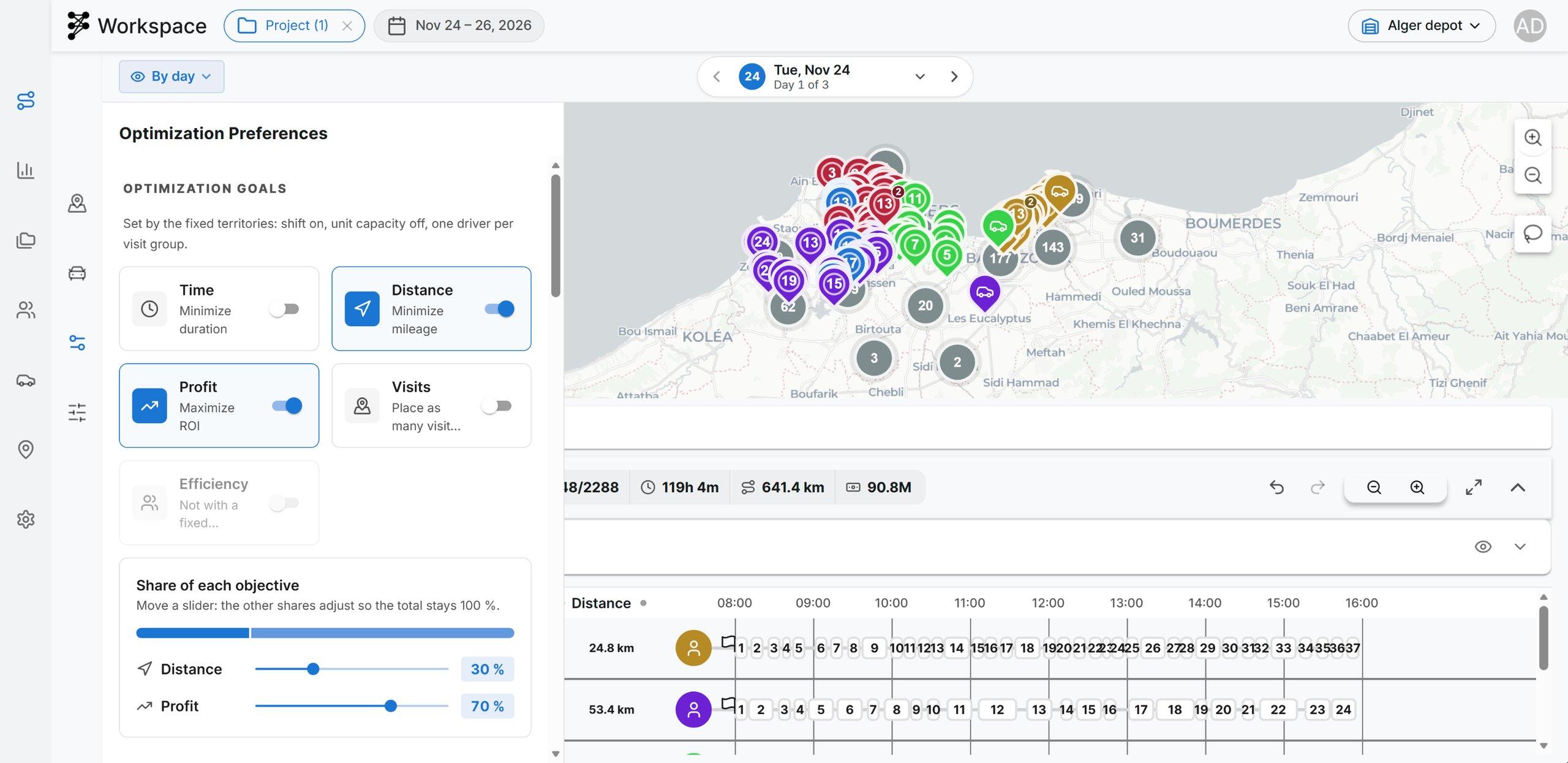
The objective is a parameter, not a setting fixed by the software. Tell Routimize what matters most for this plan and the model adapts to it, with the same data and the same rules. When priorities change, change the objective and compare the plans.
Cut what the plan costs to run: kilometres, vehicles and working time.
Favour the visits and routes that bring the most turnover for what they cost to serve.
Serve every customer at the frequency it needs, with priorities for the ones that matter most.
Fewer kilometres and fewer vehicles mean less CO₂, when clients, export partners or ESG rules ask for it.
Minimize total route time, service time included, and keep days within shifts.
Serve the same work with the smallest number of drivers, vehicles or driver-days.
In FMCG distribution, coverage comes first. Routimize plans every outlet at its visit frequency, then optimizes cost, and lists any outlet it could not fit with the reason.
Not just AI
Deciding who visits which customer, on which day, in which order, within which capacity and time window is a combinatorial problem: the number of possible plans grows faster than any amount of data can cover. A model that guesses, or imitates how people planned before, cannot guarantee a plan that works. Operations research solves it with mathematics.
What Routimize does
An optimization engine, a planning workspace for dispatchers and an app for drivers, all working on the same plan.
Plan every vehicle at once on real road distances and travel times. Set the objective for each run: lowest cost, maximum coverage, fewer kilometres and CO₂, shorter working time or fewer drivers.
Vehicle capacity by units, weight or volume; customer time windows; driver shifts and breaks; skills; stop priorities; minimum and maximum stops per driver.
Plan up to a month at a time: visit frequencies, fixed or flexible visit days, weekly routines, one territory per rep, turnover targets and balanced workloads.
Assign drivers and vehicles from several depots, see how much of each shift and vehicle is used, and estimate how many reps a territory plan needs.
Publish plans to the driver app. Drivers follow their stops, navigate, and record arrivals and completions, even offline. Dispatchers see progress live.
Import visits and drivers from Excel today. Connect your ERP or SFA through the optimization API or a connector built with our team.
Who it’s for
Routimize is strongest where routes repeat, constraints are strict and planning is done every day or every week.
Pre-sales, cash van and direct store delivery: reach every outlet, on the right day, with the team you have.
Daily multi-vehicle delivery with capacities, time windows, shifts and several depots.
Employee and team shuttles, for companies with their own fleet and for transport service providers.
Technicians, merchandisers and field teams with skills, appointment windows and shifts.
How it works
Import visits, customers, drivers and vehicles from Excel, or send them from your system through the API.
Set the objective (cost, coverage, kilometres, working time or number of drivers) and switch on the constraints your operation runs on.
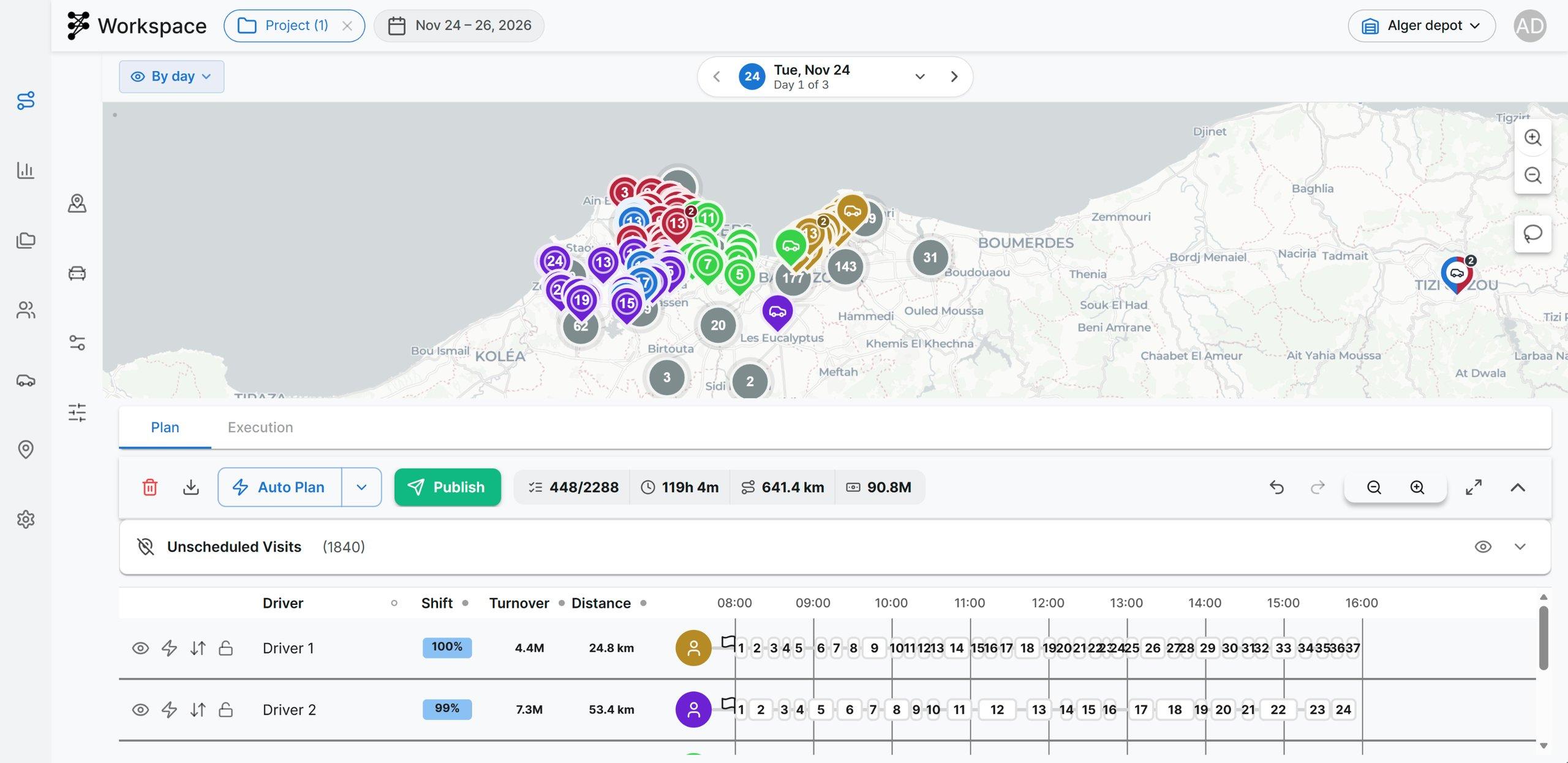
Auto Plan builds the routes in the background. Review them on the map and timeline, adjust by hand, and see why any stop could not be planned.
Publish to the driver app, follow progress live, and use each cycle’s results to tune the next plan.
Why Routimize
Generic route planners can’t model your rules. Raw optimization APIs leave you building the planning tool and the driver app. Large logistics suites take months to deploy. Routimize gives you the complete workflow, with an engine we adapt to you.
The engine is developed in-house. When your operation has a rule a standard planner can’t express, we can extend the model instead of telling you to work around it.
Capacities, time windows, shifts, breaks, skills, priorities, visit frequencies and targets are part of the model, not notes for the dispatcher.
Most route planners stop at today. Routimize also plans weeks: who visits which customer, on which days, with balanced workloads.
If a stop can’t be planned because of capacity, a shift or a time window, the plan says so and says why, so planners fix causes instead of guessing.
Keep your ERP and SFA. Routimize adds the optimization they don’t have, through Excel today and an API for deeper integration.
Road-network distances, a product available in English, French and Arabic, and a team in Algiers you can work with directly.
Integration
Your ERP or SFA manages orders and customers. It doesn’t solve which vehicle should serve which customer, when, and in what order. Routimize sits between your data and your drivers and does exactly that.
Connections to a specific ERP, SFA or TMS are scoped during the assessment and delivered as part of your deployment, so the integration matches how your data is actually organized.
Business impact
Every operation starts from a different baseline. We measure these levers on your own data, your current plan against the optimized one, before you commit.
Fewer overlapping routes and better stop sequences reduce fuel and vehicle wear.
Better use of capacity and shifts can serve the same work with fewer vehicles or driver-days.
Shorter routes that respect shifts and breaks keep days within working hours.
Planners review and adjust a generated plan instead of building it from scratch.
Visits, turnover and driving spread more evenly across drivers and reps.
Time windows and visit frequencies are planned for, not hoped for.
Proof on your data
Next step
Send us a sample of your visits, fleet and rules. We plan it with Routimize and walk you through the result: kilometres, vehicles, working time, and anything that could not be planned, with the reason why.
No commitment. You talk directly with the people who build the engine.